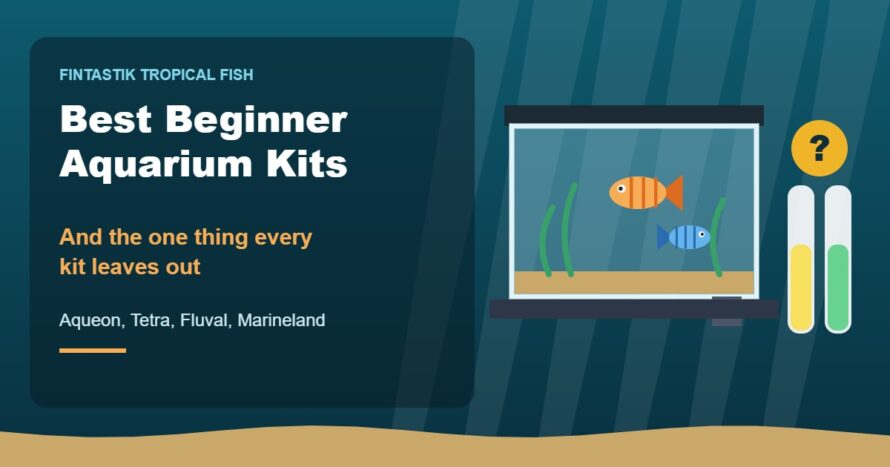
A beginner aquarium kit is one of the easiest ways to get started with tropical fish. You get a tank, a filter, a light, and often a heater in one box, and everything is matched to work together. That takes a lot of guesswork out of your first setup.
But after years of keeping and breeding tropical fish, there is one thing I have noticed about every kit on the shelf: none of them come with a way to tell whether your water is actually safe for fish. I will get to that below, because it is the most important thing to add to your cart.
Affiliate Disclosure: This page contains affiliate links. If you purchase through these links, I may earn a small commission at no extra cost to you. As an Amazon Associate, I earn from qualifying purchases. This helps support FinTastik Tropical Fish and allows me to keep providing free guides for aquarium and tropical fish keepers. I only recommend products I personally believe in and would use myself. Thank you for your support! Read our full affiliate disclosure.
Quick Picks
- Best overall: Aqueon LED Aquarium Kit, 20 Gallon
- Best smaller kit: Aqueon LED Aquarium Kit, 10 Gallon
- Best alternative 20 gallon: Tetra 20 Gallon Complete Tropical Fish Tank Kit
- Best modern look: Fluval Flex 15 Gallon Aquarium Kit
- Best for a single betta: Marineland Portrait 5 Gallon Aquarium Kit
- The one thing every kit leaves out: a liquid water test kit
What Comes in a Typical Aquarium Kit
Most beginner kits include a glass tank, a lid or hood, an LED light, and a filter with a starter cartridge. Many also add a heater, a thermometer, a small net, and sample packets of food and water conditioner. Gravel, decorations, plants, and fish are almost always sold separately.
If you would rather buy the tank and filter separately, see our guide to the best filter for a 10-gallon tank.
Kit contents change from time to time, so always check the current listing before you buy, especially for the heater.
The Best Beginner Aquarium Kits
1. Aqueon LED Aquarium Kit, 20 Gallon (Best Overall)
This is the kit I would point most beginners to first. It comes with a 20 gallon glass tank, a low-profile LED hood, a QuietFlow power filter with a cartridge, a preset 100 watt heater, a thermometer, a fish net, and sample packets of food and water conditioner. That covers nearly everything you need except gravel, decorations, and fish.
Twenty gallons is a great starting size. The extra water makes the tank more stable and more forgiving than a small tank, and it gives you room for a nice community of small fish.
- Good for: most first-time tropical fish keepers
- Keep in mind: the “20 high” shape is tall, so a 20 gallon long gives a little more swimming room if you can find one
Check the Aqueon 20 Gallon Kit on Amazon
2. Aqueon LED Aquarium Kit, 10 Gallon (Best Smaller Kit)
If you do not have room for a 20 gallon, this is the same complete package in a smaller size: 10 gallon tank, LED hood, QuietFlow filter, a preset 50 watt heater, thermometer, net, and sample food and conditioner.
A 10 gallon works well for a betta or a small group of tiny, peaceful fish. Water quality changes faster in a small tank, so regular testing and water changes matter even more. Our sister site has a good guide on what size tank a beginner should buy.
Check the Aqueon 10 Gallon Kit on Amazon
3. Tetra 20 Gallon Complete Tropical Fish Tank Kit
Tetra’s complete kit is another solid all-in-one choice. It includes a 20 gallon tank, LED lighting, a Whisper filter, a heater and thermometer, water conditioner, food samples, and decorative plants, so you have a little more to work with on day one.
- Good for: beginners who want plants and decor in the box
- Keep in mind: confirm the current version and what is included, since Tetra offers several similar kits
Check the Tetra 20 Gallon Kit on Amazon
4. Fluval Flex 15 Gallon Aquarium Kit (Best Modern Look)
The Fluval Flex has a sleek curved front and hides its filtration in a rear chamber, so you do not see a filter hanging on the back. It comes with an LED light you control with a remote, a circulation pump, and filter media including foam, carbon, and BIOMAX. It looks great in a living room or office and is popular for small planted tanks.
- Good for: people who want a clean, modern display
- Keep in mind: the heater is sold separately. The tank has a heater channel built in, so plan on adding one for tropical fish
Check the Fluval Flex 15 Gallon on Amazon and pair it with a small adjustable heater.
5. Marineland Portrait 5 Gallon Aquarium Kit (Best for a Single Betta)
The Marineland Portrait is a compact, tall kit with hidden three-stage filtration in the back and a built-in LED light. It fits on a desk or counter and makes a nice home for one betta or a few shrimp.
- Good for: a single betta, shrimp, or snails
- Keep in mind: no heater is included, and 5 gallons is too small for most community fish. Bettas are tropical, so add a small heater
Check the Marineland Portrait on Amazon and add a small heater.
The One Thing Every Kit Leaves Out: A Water Test Kit
Here is the problem. A brand-new aquarium can look crystal clear and still be dangerous for fish. Fish waste and leftover food produce ammonia, and in a new tank there are not yet enough beneficial bacteria to break it down. Ammonia and nitrite are invisible, but they can sicken or kill fish within days.
The only way to know what is happening in your water is to test it, and not one of these kits includes a proper test kit. That is why so many beginners lose their first fish and never find out why. It is also why it pays to cycle a new aquarium before adding fish.
My advice: Buy a liquid freshwater master test kit at the same time as your aquarium kit. It tests ammonia, nitrite, nitrate, and pH, and one kit lasts for hundreds of tests. Liquid tests are generally more accurate than paper strips.
What to Test and What the Numbers Mean
- Ammonia: should be 0. Any reading means fish waste is building up faster than bacteria can handle it
- Nitrite: should be 0. It is also toxic and shows the tank is not fully cycled yet
- Nitrate: some is normal in a cycled tank. Keep it low with regular partial water changes
- pH: most community fish do fine in a stable range. Stability matters more than chasing a perfect number
Test every few days while your tank is new, and anytime fish look stressed, gasp at the surface, or stop eating. Once the tank is stable, testing once a week is a good habit.
Other Things You Will Probably Need
Besides a test kit, plan on picking up a few basics that kits usually leave out or only include as samples:
- Gravel or sand: about 1 pound per gallon is a common starting point. Aquarium gravel or smooth sand for bottom dwellers like corydoras
- A full-size water conditioner: the sample runs out quickly. Water conditioner makes tap water safe at every water change
- A gravel vacuum: a gravel vacuum makes weekly water changes quick and clean
- A bucket used only for the aquarium: never use one that has held soap or cleaners
- Decorations or plants: hiding places help fish feel secure. Easy live plants like java fern and anubias also help water quality
- Bottled bacteria (optional): a bacteria starter can help a new tank cycle, but keep testing
- A heater, if your kit does not include one: most tropical fish need steady water around 75 to 80°F
- A battery air pump: a battery air pump keeps fish breathing during a power outage. See our guide to keeping your aquarium safe in a power outage
How to Choose the Right Kit
- Go as big as your space allows. A 20 gallon is easier to keep stable than a 5 or 10 gallon
- Check for a heater. Tropical fish need one. If the kit does not have it, budget for one
- Plan for the weight. Water weighs about 8.3 pounds per gallon, so a filled 20 gallon can weigh over 200 pounds. Use a sturdy stand made for aquariums
- Think about the fish first. Decide what you want to keep, then choose a kit large enough for them as adults
- Avoid tiny bowls. Small unfiltered bowls are very hard to keep healthy
Setting Up Your First Kit
- Rinse the gravel and decorations in plain water, with no soap
- Set the tank on a level, sturdy stand away from direct sunlight
- Add gravel, decorations, and plants, then fill with tap water treated with water conditioner
- Install the filter and heater, set the heater to the right temperature, and let everything run
- Cycle the tank and test the water until ammonia and nitrite read 0. Our cycling guide walks you through it step by step
- Add a few hardy fish at a time, and keep testing during the first weeks
Frequently Asked Questions
Do aquarium kits come with fish?
No. Fish are always bought separately. Wait until your tank is cycled before adding any.
Is a 5 gallon kit good for beginners?
Only for a single betta, shrimp, or snails. Small tanks change quickly, so they are actually harder to keep stable. A 10 or 20 gallon is easier for most beginners.
Can I use test strips instead of a liquid test kit?
Strips are quick and better than nothing, but liquid test kits are generally more accurate. Many experienced keepers use a liquid kit as their main test. See why test strips can mislead beginners.
How long before I can add fish?
Most new tanks take about 4 to 8 weeks to cycle. Your test kit tells you when it is ready: ammonia and nitrite both at 0, with nitrate showing up. See how to cycle a new aquarium.
Final Thoughts
A good kit makes setup easy, and the Aqueon 20 gallon is my top pick for most beginners. Whatever kit you choose, add a liquid test kit to your cart at the same time. It is the one thing every kit leaves out, and it is the best way to protect your first fish. For more help getting started, read our guide to caring for tropical fish.
Related Guides
- Aquarium Test Strips vs. a Liquid Test Kit
- Best Filter for a 10-Gallon Tank
- How to Cycle a New Aquarium
- Caring for Tropical Fish: A Beginner Guide
- How to Treat Ich in Tropical Fish
- Holiday Gift Guide for Fish Keepers
Join the conversation in one of our Facebook Groups — share photos of your aquascape, ask questions, and connect with other tropical fish enthusiasts!
For Advanced Tropical Fish & Discus Keepers:
👉 JOIN DISCUS WHATEVER ON FACEBOOK
For Beginner Fish Keepers:
👉 JOIN BEGINNERS FISH KEEPERS ON FACEBOOK