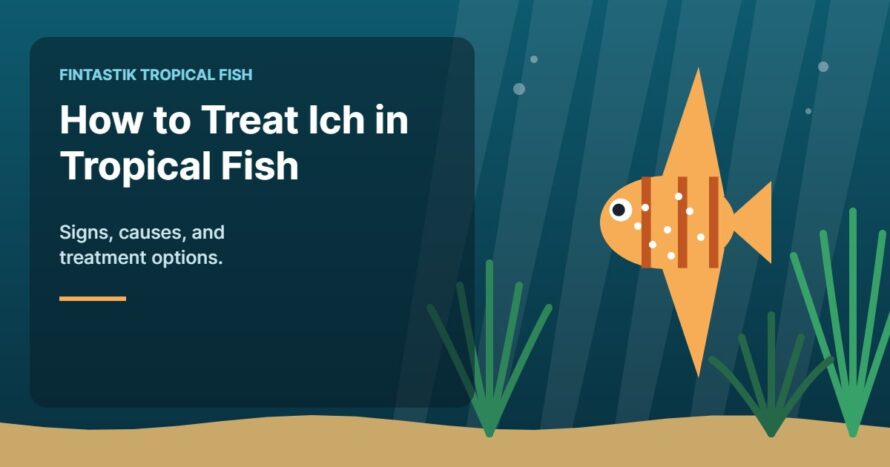
Ich, also called white spot disease, is one of the most common problems in freshwater aquariums. It shows up as tiny white spots that look like grains of salt on a fish’s body and fins. Left untreated, it can spread quickly and kill fish. The good news is that ich is very treatable when you catch it early and understand how it works.
Affiliate Disclosure: This page contains affiliate links. If you purchase through these links, I may earn a small commission at no extra cost to you. As an Amazon Associate, I earn from qualifying purchases. This helps support FinTastik Tropical Fish and allows me to keep providing free guides for aquarium and tropical fish keepers. I only recommend products I personally believe in and would use myself. Thank you for your support! Read our full affiliate disclosure.
This article is general information. If you are unsure what is wrong with your fish, or treatment is not working, ask an experienced aquarium store, a fish veterinarian, or our Facebook groups for help.
Quick Answer
- Ich is caused by a parasite called Ichthyophthirius multifiliis
- The white spots are the parasite under the skin, where treatments cannot reach it
- Treatment only kills the free-swimming stage, so you must keep treating for several days after the spots are gone
- Common treatments include ich medication, careful use of heat, and aquarium salt for fish that tolerate it
- Quarantining new fish is the best way to prevent ich
Signs of Ich
- Small white spots, like salt or sugar grains, on the body, fins, or gills
- Fish rubbing or “flashing” against rocks, gravel, or decorations
- Clamped fins
- Rapid breathing or gasping, especially if the gills are affected
- Hiding, lethargy, or loss of appetite
Ich spots are small and evenly sized. Larger, fluffy, or cotton-like patches are more likely to be fungus or another problem.
What Causes Ich?
Ich is usually brought in with new fish, plants, or water from another tank. It often appears when fish are stressed, for example after shipping, a sudden temperature drop, poor water quality, or aggressive tank mates. Stress weakens a fish’s natural defenses and gives the parasite a chance to multiply.
Understanding the Ich Life Cycle
This is the key to treating ich successfully.
- On the fish: the parasite burrows into the skin and forms a white spot. It is protected here, and medications cannot reach it
- Off the fish: the mature parasite drops off and forms a cyst on the gravel or decorations, where it divides into hundreds of new parasites
- Free-swimming: the new parasites swim off to find a fish. This is the only stage that treatment can kill
In warm water, this cycle moves faster. In cooler water, it can take much longer. That is why treatment needs to continue for several days after the last spot disappears.
How to Treat Ich
1. Test and Improve Water Quality
Start by testing the water with a liquid test kit. Fix any ammonia or nitrite problems with partial water changes, using a water conditioner and water at the same temperature as the tank.
2. Use an Ich Medication
Several medications made for ich are widely available, including ich treatments that contain ingredients such as malachite green or formalin. Follow the label closely:
- Treat the whole tank, not just one fish, because the parasite is in the water and substrate
- Remove activated carbon from the filter during treatment, because it can absorb the medication
- Use reduced doses or a different treatment for sensitive fish such as loaches, many catfish, and other scaleless fish, if the label says so
- Remove shrimp and snails first, because many ich medications can harm invertebrates
- Keep treating for the full course, and for several days after the spots are gone
3. Use Heat Carefully
Raising the temperature speeds up the ich life cycle so the treatment can reach the free-swimming stage sooner. Some keepers raise the temperature slowly to around 86°F for heat-tolerant fish, using an adjustable heater and an accurate thermometer. Warm water holds less oxygen, so add an air stone or increase surface movement. Not all fish tolerate heat, so check your species first. For discus, see our guide to heat treatment for parasites in discus fish.
4. Aquarium Salt (for Fish That Tolerate It)
Aquarium salt can help some fish fight ich. Follow the product directions, dissolve it in tank water before adding it, and increase the dose gradually. Do not use table salt with additives. Avoid salt or use it with great caution with scaleless fish, corydoras, many live plants, and invertebrates.
5. Keep Cleaning the Bottom
During treatment, regular water changes and gravel vacuuming remove some of the cysts sitting in the substrate. Re-dose medication after water changes as the label directs.
What Not to Do
- Do not stop treatment as soon as the spots disappear
- Do not mix several medications at once unless the labels say it is safe
- Do not raise or lower the temperature suddenly
- Do not add new fish to a tank with ich
How to Prevent Ich
- Quarantine new fish in a separate quarantine tank for several weeks before adding them to your main tank
- Keep the temperature stable. Sudden temperature drops are a common trigger
- Maintain good water quality with regular testing and partial water changes
- Avoid overcrowding and aggressive tank mates that stress fish
- Rinse new plants and avoid adding water from store bags to your tank
Frequently Asked Questions
Is ich contagious?
Yes. If one fish has ich, assume the whole tank is exposed and treat the entire tank.
How long does ich treatment take?
It depends on temperature and the medication, but plan on at least a week or two. Continue treatment for several days after the last spots disappear.
Can ich go away on its own?
Sometimes a healthy fish fights off a mild case, but ich can spread quickly through a tank. It is safer to treat it as soon as you see it.
Final Thoughts
Ich is common, but it does not have to be deadly. Spot it early, treat the whole tank for the full course, keep the water clean, and quarantine new fish. For more help keeping fish healthy, see our guide to caring for tropical fish.
Related Guides
- Parasites in Discus Fish: Using Heat Treatment
- Caring for Tropical Fish: A Beginner Guide
- What to Check When Discus Stop Eating
Join the conversation in one of our Facebook Groups — share photos of your aquascape, ask questions, and connect with other tropical fish enthusiasts!
For Advanced Tropical Fish & Discus Keepers:
👉 JOIN DISCUS WHATEVER ON FACEBOOK
For Beginner Fish Keepers:
👉 JOIN BEGINNERS FISH KEEPERS ON FACEBOOK