Your fish are gasping at the surface, hiding, or lying on the bottom, and your test kit shows ammonia or nitrite. This is an emergency, but it is one you can usually fix if you act quickly. Here is exactly what to do, in order, and how to keep it from happening again.
Affiliate Disclosure: This page contains affiliate links. If you purchase through these links, I may earn a small commission at no extra cost to you. As an Amazon Associate, I earn from qualifying purchases. I also earn a commission on purchases made through my Walmart, eBay and Hygger links. This helps support FinTastik Tropical Fish and allows me to keep providing free guides for aquarium and tropical fish keepers.
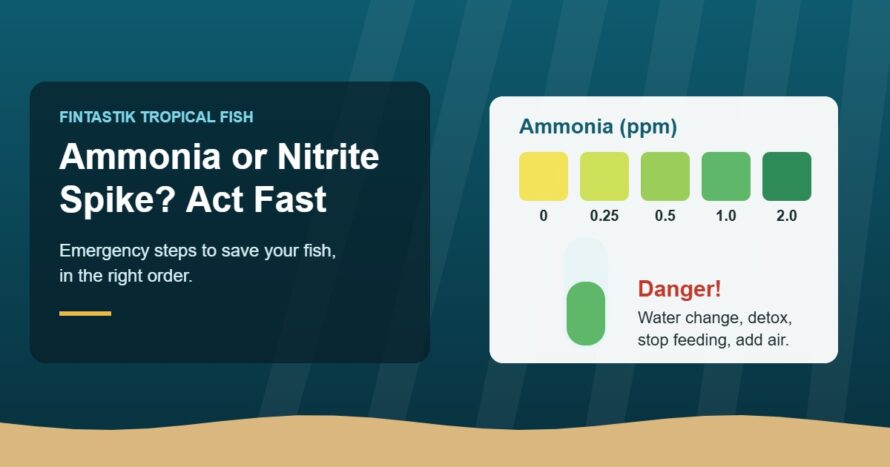
Quick answer: Test to confirm the spike. Do a 30 to 50 percent water change right away with dechlorinated water that matches the tank temperature. Dose a conditioner that detoxifies ammonia and nitrite, such as Seachem Prime, for the whole tank. Stop feeding for a day, add extra air, leave the filter alone, and test every day. Repeat water changes until ammonia and nitrite read 0, then find and fix the cause.
Signs of an Ammonia or Nitrite Problem
- Fish gasping at the surface or hanging near the filter outflow
- Red, inflamed or fast-moving gills
- Clamped fins, hiding, or lying on the bottom
- Fish that stop eating
- Sudden deaths, often a few days after new fish were added or the tank was set up
These signs can have other causes too, so test the water before you guess.
Step 1: Test to Confirm
Use a liquid test kit. Test strips can lag behind or miss a problem. The API Aquarium Water Check-Up Kit at Walmart tests ammonia and nitrite, the two that matter most here. The full API Freshwater Master Test Kit (also on eBay) adds pH and nitrate.
- 0 ppm: safe. This is where both should stay.
- 0.25 to 0.5 ppm: a problem. Act today.
- 1 ppm or more: an emergency. Act now.
Ammonia is more toxic in warm water with a high pH. If your pH is above 7, take even a small ammonia reading seriously.
Step 2: Do a Water Change Now
Change 30 to 50 percent of the water. Match the new water’s temperature to the tank, and treat it with dechlorinator before it goes in. If the reading is very high, do a second change a few hours later instead of one huge change. Very large changes all at once can shock fish with sudden swings in temperature and pH.
A gravel siphon lets you pull out waste from the gravel while you drain.
Step 3: Detoxify What’s Left
A water change lowers the ammonia, but it doesn’t remove all of it. A conditioner like Seachem Prime (also on eBay) binds ammonia and nitrite into a less toxic form for about a day, which gives your filter bacteria time to catch up. Dose it for the full tank volume, not just the new water, and you can repeat it daily while the problem lasts.
Note: most liquid ammonia tests will still show ammonia after you use Prime, because the test can’t tell bound ammonia from free ammonia. Keep testing and keep doing water changes until the reading drops.
Step 4: Stop Feeding for a Day
Food turns into ammonia. Skip feeding for 24 hours, then feed very lightly, only what your fish eat in about a minute, until the water tests clean. Healthy fish can go a few days without food.
Step 5: Add Extra Air
Fish stressed by ammonia or nitrite struggle to get oxygen. Add an air stone or a sponge filter with an air pump such as the Tetra Whisper or the hygger dual outlet air pump. Lower the water level slightly so the filter outflow splashes the surface.
Step 6: Leave the Filter Alone and Help the Bacteria
- Don’t clean or replace your filter media during a spike. The filter is where the bacteria that remove ammonia live. Never rinse filter media in tap water.
- Add bottled bacteria such as Tetra SafeStart to help the filter catch up.
- Don’t add new fish until ammonia and nitrite read 0 for several days in a row.
Step 7 (Nitrite Only): Aquarium Salt Can Help
Nitrite poisoning stops fish blood from carrying oxygen. A small dose of aquarium salt helps block nitrite from being taken up through the gills. Follow the dose on the label, and check first that your fish tolerate salt. Some catfish, like corydoras, and some live plants are sensitive to it.
Step 8: Test Every Day Until It’s Over
Test ammonia and nitrite once a day and repeat the water change whenever either one reads above 0.25 ppm. In an established tank, once you fix the cause, readings usually drop within a few days. In a brand new tank, it can take several weeks for the bacteria to fully build up.
Find the Cause
| What happened | Why it causes a spike | How to prevent it |
|---|---|---|
| New tank, fish added right away | Not enough bacteria yet | Cycle the tank first and add fish slowly |
| Overfeeding | Uneaten food rots into ammonia | Feed only what fish eat in about 2 minutes |
| A dead fish or snail | Decay releases ammonia fast | Count your fish and check behind decor |
| Many fish added at once | More waste than the bacteria can handle | Add a few fish at a time |
| Filter cleaned too hard or media replaced | Bacteria thrown away | Rinse media in old tank water; replace a little at a time |
| Power outage or filter stopped | Bacteria starve without oxygen and flow | Keep a battery air pump on hand |
| Some medications | Certain antibiotics can harm filter bacteria | Treat sick fish in a separate tank when possible |
If your tank is new, read How to Cycle a New Aquarium. If the power went out, see How to Keep Your Aquarium Safe During a Winter Power Outage.
Ammonia vs. Nitrite: What’s the Difference?
Ammonia comes straight from fish waste and rotting food. It burns gills and is the first problem in a new tank. Nitrite is what bacteria turn ammonia into, and it shows up next. Other bacteria then turn nitrite into nitrate, which is far less harmful and is removed with regular water changes. If you see nitrite rising while ammonia falls, your tank is on its way to being cycled.
What Not to Do
- Don’t do a 100 percent water change or tear the tank down. You will throw away the good bacteria and start over.
- Don’t add pH chemicals during a spike. Raising pH makes ammonia more toxic.
- Don’t keep feeding as usual.
- Don’t rely on test strips alone to tell you it’s over. See Aquarium Test Strips vs. a Liquid Test Kit.
Frequently Asked Questions
How fast can ammonia kill fish?
At high levels, especially in warm water with a high pH, ammonia can kill fish within hours to a few days. Lower levels cause slow gill damage. Treat any reading above 0 as a reason to act.
Does Seachem Prime remove ammonia?
It detoxifies ammonia and nitrite for about a day so they are much less harmful, but it doesn’t remove them. Your filter bacteria and water changes do that.
How much water should I change during an ammonia spike?
30 to 50 percent at a time, with matching temperature and dechlorinator. If the reading is still high, change more water a few hours later or the next day.
Why does my test still show ammonia after a water change?
Either there is still ammonia in the water, or you used a conditioner like Prime, which most kits still read as ammonia. Keep testing daily and keep up with water changes until the reading drops.
Can I add more fish after the spike?
Wait until ammonia and nitrite both read 0 for several days in a row, then add only a few fish at a time.
The Bottom Line
Act fast and in order: test, change water, detoxify, stop feeding, add air, and leave the filter alone. Test every day until the readings are 0, then fix the cause so it doesn’t happen again. Most ammonia and nitrite emergencies are survivable when you catch them early.
Related guides:
- How to Cycle a New Aquarium
- Cloudy Aquarium Water: White, Green or Brown?
- Aquarium Test Strips vs. a Liquid Test Kit
- Can You Build a Good Beginner Aquarium at Walmart?
Join the conversation in one of our Facebook Groups — share photos of your tank, ask questions, and connect with other tropical fish enthusiasts!
For Advanced Tropical Fish & Discus Keepers:
👉 JOIN DISCUS WHATEVER ON FACEBOOK
For Beginner Fish Keepers:
👉 JOIN BEGINNERS FISH KEEPERS ON FACEBOOK