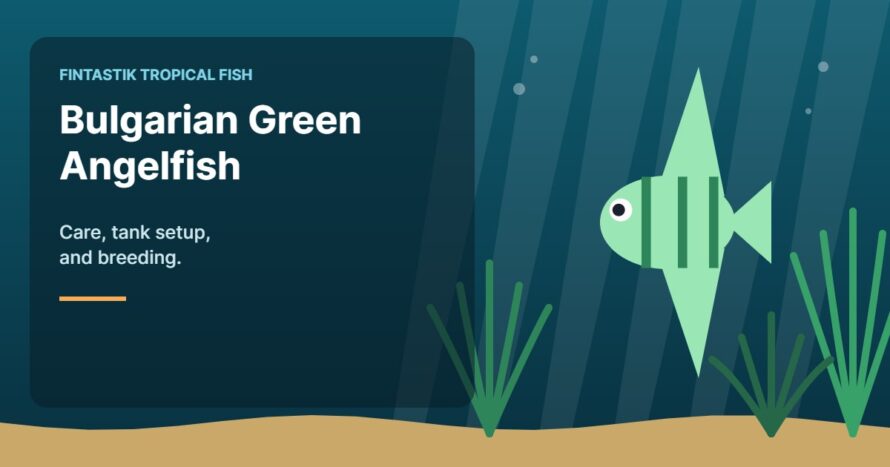
The Bulgarian Green Angelfish isn’t something you see in every fish store. Its pale body, darker fins, and greenish sheen give it a look that’s quite different from most of the angelfish varieties we’re used to seeing.
You’ll also see these fish advertised as Bulgarian Seal Point Angelfish. They have the same basic care requirements as other domestic Pterophyllum scalare, so if you’ve successfully kept angelfish before, there isn’t anything especially difficult about keeping Bulgarian Greens.
They can still be harder to find than common angelfish varieties, and good-quality fish may cost more. Here’s what you should know about keeping and breeding them.
Affiliate Disclosure: This page contains affiliate links. If you purchase through these links, I may earn a small commission at no extra cost to you. As an Amazon Associate, I earn from qualifying purchases. This helps support FinTastik Tropical Fish and allows me to keep providing free guides for aquarium and tropical fish keepers. I only recommend products I personally believe in and would use myself. Thank you for your support! Read our full affiliate disclosure.
What Is a Bulgarian Green Angelfish?
Bulgarian Green refers to a recessive angelfish color gene usually written as bg. Bulgarian Seal Point is one of the best-known color forms produced when Bulgarian Green is combined with Dark angelfish genetics.
You’ll sometimes see the two names used almost interchangeably by sellers, but technically they aren’t exactly the same thing.
Depending on the individual fish and the aquarium lighting, the body may look greenish, blue-green, silver, or almost platinum. The dark dorsal and anal fins on Seal Point-type fish create a striking contrast against the lighter body.
The green coloration can also be surprisingly hard to capture in photographs. A fish that looks strongly green in person may look much more silver in a picture.
As with many selectively bred angelfish, appearance can vary between breeders. When buying them, look for a well-shaped body, straight fins, healthy swimming behavior, and good overall condition rather than choosing on color alone.
How Big Do They Get?
Bulgarian Greens grow to about the same size as other domestic angelfish.
Adult angelfish can reach around 6 inches in length and may be considerably taller when you include their long dorsal and anal fins.
That’s why tank height matters with angelfish. They’re tall fish and need enough room to fully extend their fins.
Tank Setup
| Parameter | Recommendation |
|---|---|
| Tank size | 29–30 gallons tall can work for a breeding pair; 55+ gallons is better for several angels or a community |
| Temperature | 76–84°F (24–29°C) |
| pH | Around 6.0–8.0 |
| Water hardness | Adaptable to a range of hardness levels |
| Filtration | Good filtration without excessive current |
One thing I wouldn’t do is chase a particular pH number. Bulgarian Greens are captive-bred angelfish and can adapt to a fairly wide range of water conditions.
Clean, stable water is more important than trying to hit a perfect pH. A reliable heater and a test kit help you keep things steady, and a sponge filter provides good filtration without a strong current.
A 29- or 30-gallon tall aquarium can work for a bonded breeding pair, but I prefer more room whenever possible. For several angelfish or a community tank, I’d look at 55 gallons or larger.
Angelfish also appreciate vertical surfaces. Amazon sword leaves, pieces of slate, and spawning cones all give them places to investigate and, if you have a breeding pair, somewhere to lay their eggs.
Live plants look especially good with this strain. The pale body and darker fins stand out against a planted background. Java fern and Anubias are easy choices if you don’t want a demanding planted aquarium.
Tank Mates
Bulgarian Greens are generally peaceful, but they’re still angelfish and individual personalities can vary.
Good tank mates can include:
-
- Larger peaceful tetras
-
- Corydoras
-
- Bristlenose plecos
-
- Other peaceful community fish that won’t nip fins
I’d be careful with known fin-nippers such as tiger barbs and serpae tetras. Those long angelfish fins can be tempting targets.
Very small fish can also become food once an angelfish gets large enough. Neon tetras and similar-sized fish sometimes live successfully with angels, especially if they grow up together, but there is always some risk.
If you’re planning to breed your Bulgarian Greens, a pair is usually easier to manage in its own tank. Once angelfish start spawning, they can become very territorial.
Feeding
Bulgarian Green Angelfish aren’t difficult to feed.
A good-quality flake or small pellet can make up the basic diet, with frozen or live foods added for variety.
Good choices include:
-
- Brine shrimp
-
- Mysis shrimp
-
- Bloodworms as an occasional food
-
- Other quality frozen or live foods
I’ve also fed beef-heart mixes to my angelfish and other fish for years, particularly when growing angelfish and discus. It isn’t something you have to feed to keep angelfish healthy, but it has worked well for me.
Small feedings once or twice a day are usually better than dumping a large amount of food into the tank at one time.
Watch the fish eat and adjust the amount accordingly. You don’t want uneaten food sitting on the bottom and affecting water quality.
Breeding Bulgarian Green Angelfish
Breeding Bulgarian Greens is basically the same as breeding other domestic angelfish.
1. Let a Pair Form
Sexing young angelfish can be difficult.
One of the easiest methods is to start with a group of young fish and let them mature together. Eventually, a compatible male and female will usually pair off.
2. Condition the Pair
When I bred my Bulgarian Green Angelfish, I kept them in soft water at around 75 ppm TDS and about 80°F. That setup worked well for me. A TDS meter makes it easy to check.
Feed the pair a varied, high-quality diet and keep their water clean.
Regular water changes, good feeding, and stable temperatures often help encourage spawning.
3. Give Them a Spawning Surface
Angelfish naturally lay their eggs on vertical or nearly vertical surfaces.
They may choose:
-
- A broad plant leaf
-
- A piece of slate
-
- Filter tubes
-
- Even the aquarium glass
Once a pair decides where they want to spawn, they’ll usually clean the area before laying eggs.
4. Spawning
The female lays rows of eggs and the male follows behind fertilizing them.
A mature pair can lay several hundred eggs, although the number varies depending on the size and age of the female.
Both parents may guard and fan the eggs.
5. Hatching
At around 80°F, angelfish eggs usually hatch in around 3 days.
The fry remain attached as wigglers and feed from their yolk sacs for about 5 more days before becoming free-swimming.
6. Feeding the Fry
Once the fry become free-swimming, freshly hatched baby brine shrimp is one of the best foods you can give them.
I’ve used baby brine shrimp for angelfish fry for many years. It’s nutritious, the movement encourages fry to eat, and you can easily see their bellies fill after feeding.
If you’re selectively breeding Bulgarian Greens, keep good records on the parents and youngsters. Color and fin darkness can vary, and not every youngster will look exactly like its parents.
Good body shape and healthy development should always be more important than simply producing the darkest or greenest fish.
Are Bulgarian Green Angelfish Worth Keeping?
If you already enjoy angelfish and want something a little different, Bulgarian Greens are certainly worth considering.
They aren’t more difficult to care for than other domestic angelfish. Their main difference is their appearance and genetics, not their basic needs.
Give them a tall aquarium, clean stable water, good food, and enough room, and care for them just as you would any other quality angelfish.
The harder part may simply be finding healthy, well-bred fish from a breeder you trust.
Related Reading
Join the conversation in one of our Facebook Groups — share photos of your aquascape, ask questions, and connect with other tropical fish enthusiasts!
For Advanced Tropical Fish & Discus Keepers: 👉 JOIN DISCUS WHATEVER ON FACEBOOK
For Beginner Fish Keepers: 👉 JOIN BEGINNERS FISH KEEPERS ON FACEBOOK