An angelfish display tank is a tank set up to show off angelfish at their best: tall, calm, planted, and stocked with tank mates that leave those long fins alone. Angelfish are one of the most graceful fish you can keep, but they need a different setup than most community fish. Get the tank right from the start and they will reward you for years.
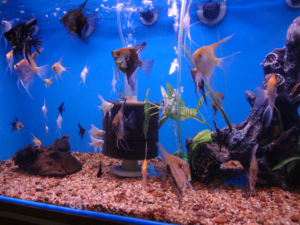
Angelfish Display Tank
Affiliate Disclosure: This page contains affiliate links. If you purchase through these links, I may earn a small commission at no extra cost to you. As an Amazon Associate, I earn from qualifying purchases. I also earn a commission on purchases made through my Hygger links. This helps support FinTastik Tropical Fish and allows me to keep providing free guides for aquarium and tropical fish keepers. I only recommend products I personally believe in and would use myself. Thank you for your support! Read our full affiliate disclosure.
Angelfish Display Tank at a Glance
| Tank size | 55 gallons for a group of 4 to 6; a 29-gallon tall tank can hold a single pair |
| Tank height | At least 18 to 20 inches tall |
| Temperature | 76–82°F (24–28°C) |
| pH | 6.5 to 7.5 |
| Water flow | Low to moderate |
| Decor | Tall plants, upright driftwood, open swimming space |
| Temperament | Mostly peaceful, but pairs defend their spawning spot |
| Adult size | About 6 inches long and up to 8 inches tall with fins |
Why Tank Height Matters More Than Length
Angelfish grow tall, not just long. A full-grown angelfish can stand 8 inches from the tip of its top fin to the tip of its bottom fin. In a short tank those fins brush the gravel and the surface, and the fish never looks its best. That is why a standard 55-gallon tank, which is about 21 inches tall, is such a popular choice for angelfish. If you shop for a smaller tank, look for one labeled “tall.”
How Many Angelfish Should You Keep?
Angelfish are happiest in a small group. Most keepers buy 5 or 6 young angelfish and let them grow up together. As they mature, two of them will often pair off. A pair that is guarding eggs can push the others around, so watch them closely. If one pair takes over the tank, you may need to move the extra angelfish to another tank.
A single angelfish can live a good life too, as long as it has calm tank mates. What you want to avoid is two adults that do not get along with no room to get away from each other.
Filtration and Gentle Water Flow
Wild angelfish come from slow, quiet waters in South America. They do not like being pushed around by a strong current. You still need strong filtration to keep the water clean, so the trick is to spread the flow out.
- A Fluval 407 canister filter is a good match for a 55-gallon tank. Point the outlet at the glass or use a spray bar so the water comes out gently.
- An air-driven sponge filter adds extra filtration with almost no current. It makes a great second filter for angelfish tanks.
- If your angelfish are always fighting the current or hiding in one corner, the flow is too strong.
Rick’s Tip: Keep a Spare Sponge Filter Running
As a breeder, I always kept a spare sponge filter running in my established tanks, including the tanks where parent fish were raising their fry. That sponge filled up with good bacteria. When it was time to move the young fish to their own tank, the seeded filter went with them, and the new tank was protected from day one. If you ever plan to set up a second tank, start a spare sponge filter now.
Heater and Temperature
Angelfish are tropical fish and need warm, steady water, around 78°F for most tanks. Use a reliable aquarium heater sized for your tank and check the temperature every day. Big swings in temperature stress angelfish and can bring on diseases like ich.
Lighting
Moderate lighting is plenty. Angelfish can be startled when the lights snap on in a dark room, so it helps to put your aquarium light on a timer. Turn on the room lights first, then the tank light. The same daily schedule also helps your plants and keeps algae under control.
Plants, Driftwood and Decor
A display tank should look like the kind of place angelfish come from: tall stems, roots and leaves, with open water in the middle.
- Tall plants: Amazon swords and vallisneria grow tall and give angelfish places to rest and hide.
- Upright driftwood: Driftwood standing up and down matches the vertical bars on an angelfish and looks natural.
- A spawning surface: Angelfish lay their eggs on smooth, upright surfaces like broad leaves or a piece of slate leaned against the glass.
- Open swimming space: Keep the front and center of the tank open so you can see your fish.
- A dark background: A black or dark blue background makes silver and marbled angelfish stand out.
For more ideas, see Designing Your Dream Aquascape.
Choosing Tank Mates
Angelfish are peaceful most of the time, but they are cichlids. Anything small enough to fit in an adult angelfish’s mouth may become a snack, and fin-nipping fish will chew up those long fins.
Good tank mates
- Corydoras catfish
- Bristlenose plecos
- Larger, peaceful tetras like black skirt or rummy nose tetras
- Pearl gouramis
- Peaceful barbs that do not nip, like cherry barbs in a large group
Tank mates to avoid
- Fin nippers like tiger barbs and serpae tetras
- Very small fish like neon tetras, which adult angelfish often eat
- Aggressive cichlids
- Goldfish. They need cooler water. At my store, I saw people put goldfish in with angelfish again and again, and it never works.
Feeding Angelfish
Angelfish are not picky. Feed a quality flake or pellet food as the main diet, and add frozen bloodworms or brine shrimp a few times a week for color and condition. Feed only what they eat in a minute or two, once or twice a day. Overfeeding is one of the most common mistakes in a display tank, because leftover food fouls the water.
Setting Up Your Angelfish Display Tank, Step by Step
- Place the tank on a stand made for its weight, away from windows and heater vents.
- Add sand or fine gravel, then your driftwood and rocks.
- Fill the tank, add water conditioner, and plant your swords and other tall plants.
- Start the filter and heater, and set the light on a timer.
- Cycle the tank for 3 to 4 weeks before adding fish. Test with a liquid test kit until ammonia and nitrite read 0. Here is how: how to cycle a fish tank.
- Add the peaceful bottom dwellers first, then the angelfish as young fish.
Keeping the Display Looking Good
- Change about 25% of the water every week.
- Clean the filter only when the flow slows down, and rinse filter media in old tank water. Never rinse filter media in tap water, because it kills the good bacteria.
- Trim plants so the front stays open.
- Watch your angelfish when you feed them. A fish that stops eating is often the first sign of trouble.
Angelfish Display Tank FAQ
Can angelfish live in a 29-gallon tank?
A 29-gallon tall tank can work for one pair of angelfish with a few small, peaceful bottom fish. For a group of angelfish, go with 55 gallons or more.
How tall should an angelfish tank be?
Aim for at least 18 to 20 inches tall. Taller is better, because adult angelfish can be 8 inches from fin tip to fin tip.
Why are my angelfish fighting?
Usually a pair has formed and is claiming part of the tank to spawn. More plants and driftwood to break up their view helps. If one fish is getting beaten up, separate it.
Can I keep just one angelfish?
Yes. A single angelfish with calm tank mates can do very well and often becomes the star of the tank.
Final Thoughts
A good angelfish display tank is tall, calm, well filtered and well planted, with tank mates that respect those fins. Cycle it before you add fish, keep the water steady, and do not overfeed. If you are drawn to the color forms, take a look at the Bulgarian Green Angelfish.
Join the conversation in one of our Facebook Groups — share photos of your aquascape, ask questions, and connect with other tropical fish enthusiasts!
For Advanced Tropical Fish & Discus Keepers: 👉 JOIN DISCUS WHATEVER ON FACEBOOK
For Beginner Fish Keepers: 👉 JOIN BEGINNERS FISH KEEPERS ON FACEBOOK