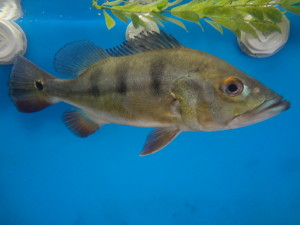
Peacock bass, also known as tucunaré or Cichla, are freshwater fish native to the Amazon and other river basins of South America. They are members of the cichlid family, which also includes well-known aquarium fish such as the angelfish and the discus. Peacock bass are known for their vibrant colors and for their aggressive behavior and strong fighting ability, which makes them popular among sport fishermen. During breeding season, males develop a noticeable hump on the forehead, called a nuchal hump.
They are typically found in still waters such as lakes and swamps, as well as in slow-moving parts of rivers and creeks, and they feed on smaller fish and crustaceans. Size depends on the species. The butterfly peacock bass commonly reaches about 24 inches (60 cm) and up to around 10 pounds (4.5 kg), while the largest species, the speckled peacock bass, can top 3 feet and 25 pounds.
Peacock bass have been introduced outside their native range. Florida stocked butterfly peacock bass on purpose in 1984 to help control other non-native fish, and they were introduced to Hawaii decades earlier. Because of this, they are considered non-native or invasive in some places.
Affiliate Disclosure: This page contains affiliate links. If you purchase through these links, I may earn a small commission at no extra cost to you. As an Amazon Associate, I earn from qualifying purchases. This helps support FinTastik Tropical Fish and allows me to keep providing free guides for aquarium and tropical fish keepers. I only recommend products I personally believe in and would use myself. Thank you for your support! Read our full affiliate disclosure.
Can You Keep a Peacock Bass in an Aquarium?
Yes, but only if you’re prepared for a very large, fast-growing predator. Juvenile peacock bass are sometimes sold at just a few inches long, and they look manageable in the store. They grow quickly, though, and an adult needs one of the biggest aquariums you can give it. Before buying one, also check your local and state regulations, since some areas restrict keeping live peacock bass. Never release one into the wild.
Quick Facts
| Scientific name | Cichla species (butterfly peacock bass is Cichla ocellaris) |
| Origin | Amazon and other South American river basins |
| Adult size | About 2 feet for smaller species; over 3 feet for the largest |
| Minimum tank | 180+ gallons for smaller species; much larger for big species |
| Temperature | 76–84°F (24–29°C) |
| pH | About 6.0–7.5 |
| Diet | Carnivore (predator) |
| Temperament | Predatory; eats anything that fits in its mouth |
Tank Size and Setup
Peacock bass are active, powerful swimmers. Even the smaller species need a 180-gallon aquarium or larger as adults, and the big species need far more room than most homes can offer. A long, wide tank gives them space to turn and cruise.
-
- Secure lid: They can jump when startled. Use a heavy, tight-fitting lid.
-
- Substrate: Sand or a bare bottom. Bare bottom is easier to keep clean with a messy predator.
-
- Decor: Keep it simple and sturdy. A few large pieces of driftwood or smooth rocks, with plenty of open swimming space. Anything loose may get rearranged.
Water Conditions and Filtration
Keep the temperature between 76°F and 84°F with a heater sized for a large tank, and check it with a thermometer. A pH of roughly 6.0 to 7.5 suits them. As with most fish, stable water is more important than a perfect number.
Big predators produce a lot of waste. Use heavy-duty filtration, such as one or more large canister filters or a sump, rated well above the tank’s volume. Keep the surface moving for oxygen with an air pump if needed.
Plan on large weekly water changes, around 30–50%. A Python water changer makes that practical on a big tank, and a conditioner like Seachem Prime treats large volumes of tap water economically. Check ammonia, nitrite, and nitrate regularly with a test kit.
Feeding
Peacock bass are predators that eat mostly fish in the wild. In an aquarium, the healthiest approach is to train them onto prepared foods while they’re young. Good options include:
-
- Large carnivore pellets as the staple
-
- Krill and shrimp
-
- Frozen silversides or other frozen fish
Avoid relying on live feeder goldfish. They can carry parasites and disease, and a goldfish-heavy diet isn’t good long-term nutrition. Feed young fish once or twice a day and adults a few times a week, and remove leftovers promptly.
Tank Mates
Any fish small enough to fit in a peacock bass’s mouth will be eaten. Tank mates must be large, robust, and able to hold their own, such as large plecos or other big South American fish in a very large tank. Some keepers house them with arowanas in huge setups. See my guides to the Silver Arowana and Black Arowana. Many keepers simply keep a peacock bass on its own.
Is a Peacock Bass Right for You?
For most fishkeepers, a peacock bass is a fish to admire on the end of a fishing line rather than in the living room. But if you have the space for a very large aquarium, strong filtration, and the commitment to big weekly water changes, a peacock bass can be a bold, colorful, and interactive pet that recognizes its owner at feeding time.
Join the conversation in one of our Facebook Groups — share photos of your aquascape, ask questions, and connect with other tropical fish enthusiasts!
For Advanced Tropical Fish & Discus Keepers: 👉 JOIN DISCUS WHATEVER ON FACEBOOK
For Beginner Fish Keepers: 👉 JOIN BEGINNERS FISH KEEPERS ON FACEBOOK