A sponge filter is about the simplest filter you can put in a fish tank. Air goes down the tube, bubbles come up, and water gets pulled through the sponge. So when it stops bubbling, or the whole thing floats up off the bottom, the fix is almost always simple too. This guide walks through every common cause, from the airline to the pump, in the order I’d check them.
Affiliate Disclosure: This page contains affiliate links. If you purchase through these links, I may earn a small commission at no extra cost to you. As an Amazon Associate, I earn from qualifying purchases. I also earn a commission on purchases made through my Walmart, eBay and Hygger links. This helps support FinTastik Tropical Fish and allows me to keep providing free guides for aquarium and tropical fish keepers.
Quick answer: If your sponge filter isn’t bubbling, work from the pump to the sponge. Make sure the pump is running and pushing air. Then check the airline for kinks or cracks, check that the check valve isn’t stuck or in backward, and check that the gang valve is open. If air reaches the filter but the bubbles are weak, the sponge or air stone may be clogged, the pump may be too small for the tank depth, or the pump’s diaphragm may be worn out. If the sponge floats, air is trapped inside it or the base isn’t heavy enough.
How a Sponge Filter Works (and Why It Stops)
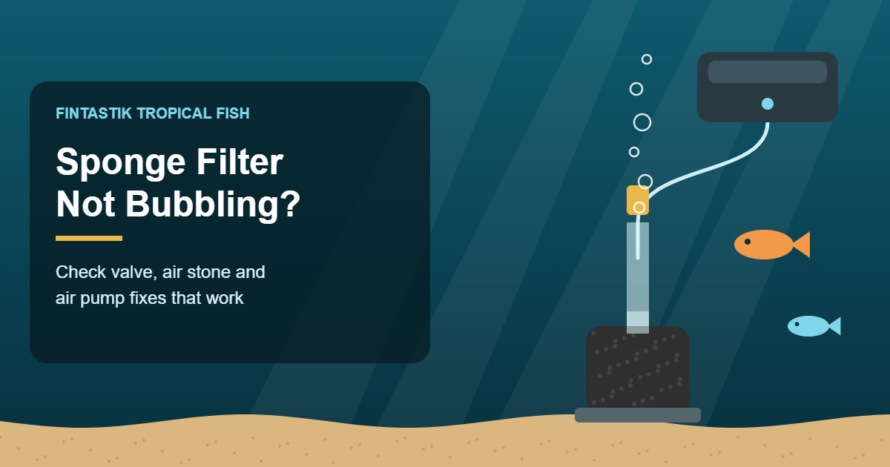
A sponge filter has no motor. An air pump outside the tank pushes air through airline tubing into the filter’s lift tube. As the bubbles rise, they pull water up the tube. That water has to come through the sponge first, so dirt gets trapped and beneficial bacteria grow on the sponge.
That means anything that blocks or leaks the air will slow the filter down. And anything that blocks the water, like a sponge packed with gunk, will slow it down too. Most problems fall into one of these:
- No air getting to the filter
- Air leaking out before it gets there
- Not enough air pressure for the water depth
- A clogged sponge or air stone
- Trapped air making the filter float
Step 1: Is the Air Pump Running?
Start at the pump. Put your hand near the outlet with the airline pulled off. You should feel a steady push of air. If you feel nothing and hear nothing, check the outlet, the plug and any power strip switch.
If the pump hums but the air is weak, the rubber diaphragm inside is probably worn or torn. Diaphragms wear out over time on every vibrator-style pump. I wrote a full guide on that: Aquarium Air Pump Weak or One Side Stopped? How to Fix It. You can replace the diaphragm with a new repair kit made for your pump model, or just replace the pump.
Good, simple pumps for one or two sponge filters:
- Tetra Whisper Air Pump (up to 10 gallons) at Walmart
- Tetra Whisper AP150 for deeper water at Walmart
- Hygger Dual Max Aquarium Air Pump (two outlets, handy for two filters)
Step 2: Check the Airline Tubing
Run your fingers along the whole length of the tubing. Look for:
- Kinks. Tubing often gets pinched behind the tank, under a lid or against the stand.
- Cracks or holes. Old tubing turns stiff and splits, usually right where it slides over a fitting.
- Loose ends. If the tube has stretched out, it won’t seal on the nozzle. Cut off the stretched inch and push it back on.
- Clogs. Salt, slime or mineral crust can build up inside, especially near the water.
Tubing is cheap. If yours is yellow and stiff, just replace it. Vibrant Life airline tubing at Walmart works fine.
Step 3: Check the Check Valve
A check valve lets air go one way and keeps water from siphoning back into the pump if the power goes out. It’s a good part to have. But it’s also one of the most common reasons a sponge filter stops bubbling.
- Installed backward. The arrow, or the colored side, should point toward the tank. If it’s backward, no air gets through.
- Stuck shut. Check valves can gum up or stick, especially after they get wet. Pull it off and blow through it the way the arrow points. If air won’t pass easily, replace it.
- Stuck open. This won’t stop bubbles, but it won’t protect your pump either. Blow the wrong way. If air passes, it’s done.
Penn-Plax makes a 3-way air control splitter with a safety check valve, sold at Walmart, which covers both the valve and splitting air to more than one filter.
Step 4: Gang Valves and Splitters
If you run several filters off one pump, the gang valve is a common trouble spot. A lever that got bumped shut, a cracked valve body or a loose fitting will leak air. One easy test: listen and feel for hissing at each joint with the pump running. A little water dabbed on a fitting will bubble if it leaks.
Also remember that air takes the easy way out. If one filter sits in shallow water and another sits deep, the shallow one will hog the air. Close the valve a little on the shallow side to push more air to the deep one.
Step 5: Is the Sponge or Air Stone Clogged?
If air reaches the filter but only a weak trickle of bubbles comes up, look at the filter itself.
A clogged sponge. Over time the sponge packs with fish waste and food. Water can’t get through, so flow drops even if the air is fine. To clean it:
- Take out a bucket of old tank water during a water change.
- Pull the sponge and squeeze it several times in that tank water until the water runs mostly clear.
- Put it back. Don’t scrub it spotless.
Never rinse filter media in tap water. Chlorine or chloramine in tap water can kill the beneficial bacteria living in the sponge, and that can lead to an ammonia spike. If that happens, see how to handle an ammonia or nitrite spike.
A clogged air stone. Some sponge filters have an air stone inside the lift tube. Stones clog with slime and minerals. Pull the airline off the stone and run the pump. If the air comes out strong without it, replace the stone.
Step 6: Is the Pump Too Small for the Tank Depth?
This one catches a lot of people. Water pushes back against the air. The deeper the filter sits, the more pressure the pump needs. A small pump that works fine in a 10-gallon may barely bubble at the bottom of a tall 55 or 75-gallon.
If your pump is running, your tubing is good and your sponge is clean but the bubbles are still weak, try lifting the filter higher in the tank for a minute. If the bubbles pick up, depth is the problem. Get a pump rated for deeper water, like the Tetra Whisper AP150.
Why Is My Sponge Filter Floating?
A floating sponge filter is almost always trapped air or a light base.
- New sponge. New sponges are full of air. Squeeze it underwater several times until no more bubbles come out.
- Light or missing base. Many sponge filters come with a weighted base. If yours doesn’t have one, or it fell off, the filter will tip and float. Push the base on tight, or set a smooth, clean rock against it.
- Air leaking into the sponge. If the airline comes loose inside the filter, air fills the sponge instead of going up the tube. Reseat the airline on the nozzle.
Quick Troubleshooting Table
| What you see | Likely cause | Fix |
|---|---|---|
| No bubbles at all | Pump off, check valve backward or stuck, gang valve closed | Check power, flip or replace check valve, open valve |
| Weak bubbles | Kinked or cracked tubing, worn diaphragm, clogged air stone | Replace tubing, rebuild or replace pump, replace stone |
| Bubbles fine but little flow | Clogged sponge | Squeeze sponge in old tank water |
| Good in shallow water, weak deep | Pump too small for depth | Use a pump rated for deeper water |
| Some filters strong, others weak | Uneven gang valve or leaks | Balance valves, check fittings |
| Filter floats | Trapped air, light base, loose airline | Squeeze out air, weight the base, reseat airline |
What I Did as a Breeder
When I was breeding, I always kept a spare sponge filter running, including in tanks where the parents were raising fry. When the fry were ready to move to their own tank, that seeded spare went with them. That way the new tank had working bacteria from day one.
At my store, the breeding and grow-out rooms ran on central air from Jehmco linear piston pumps, one LPH80 and two LPH26. When the sponge filters in the deep tanks started losing air, it was usually because the pumps were wearing out. I rebuilt those worn pumps with parts kits, and the air came back.
The lesson: when lots of filters get weak at once, look at the pump first. When one filter gets weak, look at that filter’s line, valve and sponge.
Where to Get a Sponge Filter
- Shorefins air-driven sponge filter (up to 20 gallons) at Walmart
- New sponge filters on eBay
- Sponge filters on Amazon
If you’re still choosing a filter for a small tank, my best filter for a 10-gallon tank guide compares sponge filters with hang-on-back filters.
Frequently Asked Questions
Why did my sponge filter stop bubbling after a power outage?
Water may have siphoned back into the airline, or the check valve may have stuck. Clear the line and test the valve. A sponge filter that sat without air for hours may also have lost some bacteria. See what to do in a power outage.
How often should I clean a sponge filter?
When the flow slows down. For most tanks that’s every few weeks. Squeeze it in old tank water and put it right back.
Can I run a sponge filter without an air stone?
Yes. Many sponge filters work fine without one. The stone makes smaller bubbles and is a little quieter, but it can clog.
Do I need a check valve?
If your pump sits below the water line, yes. It helps keep water from siphoning back into the pump if the power goes out. Just make sure it points the right way.
Can one air pump run two sponge filters?
Yes, with a two-outlet pump or a splitter. Make sure the pump has enough air for both, especially in deeper tanks.
The Bottom Line
A sponge filter that isn’t bubbling is almost never broken. Check the pump, the tubing, the check valve and the gang valve first. Then clean the sponge in old tank water and check the air stone. If it’s still weak, the pump may be too small for the depth or need a new diaphragm. And if it floats, squeeze out the trapped air and weight the base. Keep a spare sponge filter running if you can. It’s cheap insurance.
Related guides:
- Aquarium Air Pump Weak or One Side Stopped? How to Fix It
- Best Filter for a 10-Gallon Tank
- How to Keep Your Aquarium Safe During a Winter Power Outage
- Ammonia or Nitrite Spike in Your Aquarium? Emergency Steps to Save Your Fish
Join the conversation in one of our Facebook Groups — share photos of your tank, ask questions, and connect with other tropical fish enthusiasts!
For Advanced Tropical Fish & Discus Keepers:
👉 JOIN DISCUS WHATEVER ON FACEBOOK
For Beginner Fish Keepers:
👉 JOIN BEGINNERS FISH KEEPERS ON FACEBOOK