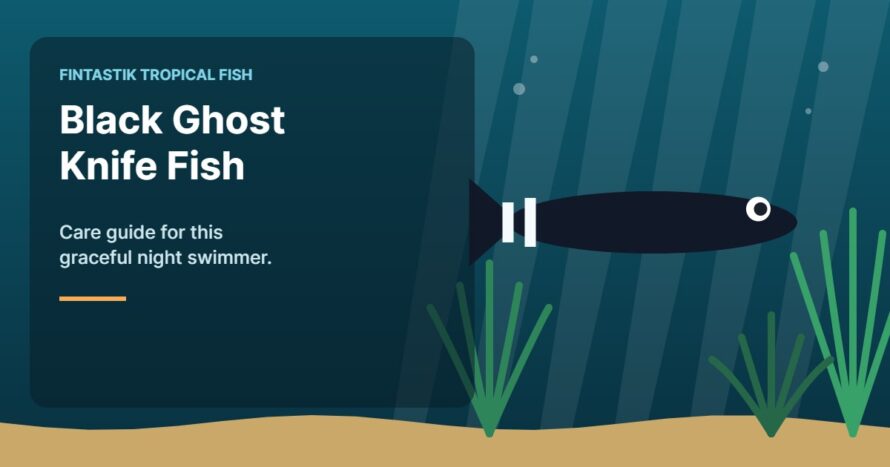
The Black Ghost Knife Fish (Apteronotus albifrons) is one of the most unusual fish you can keep in a freshwater aquarium. It has no dorsal fin and no proper tail fin. Instead, it glides forward and backward by rippling one long fin that runs along the underside of its body. Add the jet-black body, two white rings near the tail, and a white stripe on the nose, and you have a fish that really does look like a ghost moving through the water.
They’re peaceful, intelligent, and fascinating to watch, but they also get big and have a few special needs. Here’s what you should know before bringing one home.
Affiliate Disclosure: This page contains affiliate links. If you purchase through these links, I may earn a small commission at no extra cost to you. As an Amazon Associate, I earn from qualifying purchases. This helps support FinTastik Tropical Fish and allows me to keep providing free guides for aquarium and tropical fish keepers. I only recommend products I personally believe in and would use myself. Thank you for your support! Read our full affiliate disclosure.
Quick Facts
| Scientific name | Apteronotus albifrons |
| Origin | Amazon River basin, South America |
| Adult size | Up to about 18–20 inches; often smaller in home aquariums |
| Minimum tank | 100+ gallons for one adult |
| Temperature | 73–82°F (23–28°C) |
| pH | 6.0–8.0 |
| Temperament | Peaceful but shy; can be territorial with other knifefish |
| Diet | Carnivore |
| Activity | Nocturnal (most active at night) |
A Fish That “Sees” With Electricity
Black Ghost Knife Fish have poor eyesight. To find their way around and locate food in dark, murky water, they produce a weak electric field and sense changes in it. This is called electrolocation. It’s far too weak to hurt you or other fish, but it explains a few of their habits: they spend the day tucked away, come out after dark, and tend to be uneasy around other electric fish.
Tank Size
A juvenile in the store may be only a few inches long, but these fish keep growing. Plan for the adult. A 125-gallon aquarium or larger is a good long-term home for one adult. Length matters more than height, because they need room to swim forward and back.
Use a tight-fitting lid. Knife fish can squeeze through surprisingly small gaps.
Water Conditions
Keep the temperature between 73°F and 82°F with a reliable heater sized for your tank, and confirm it with a separate thermometer. A pH between 6.0 and 8.0 is fine. As with most captive-bred and long-imported fish, stable water matters more than chasing a perfect number.
Black Ghost Knife Fish are sensitive to poor water quality. Ammonia and nitrite should stay at zero and nitrate should be kept low. Test regularly with a freshwater test kit.
Filtration and Oxygen
A large carnivore produces a lot of waste, so use strong filtration. A large canister filter rated for your tank size is a good choice. Aim for good circulation without blasting the fish around, and keep the water surface moving for oxygen. An air stone and air pump can help.
Setting Up the Tank
Because they’re shy and nocturnal, the setup should help them feel safe:
-
- A hiding tube: This is the most important piece of decor. Black Ghost Knife Fish love to rest inside a tube or long cave during the day. A length of smooth PVC pipe or a ready-made hide tube wide enough for the adult fish works well.
-
- Soft substrate: Use aquarium sand or smooth fine gravel. They like to poke around the bottom, and sharp gravel can scratch them.
-
- Dim lighting: Bright light keeps them hidden. Subdued lighting, floating plants, or shaded areas encourage them to come out more.
Make sure the heater and filter intakes are guarded or placed where the fish can’t wedge itself against them. A heater guard is inexpensive insurance.
Feeding
Black Ghost Knife Fish are carnivores. Good foods include:
-
- Live blackworms or freeze-dried blackworms (a favorite)
-
- Frozen bloodworms and brine shrimp
-
- Sinking carnivore pellets or wafers, once they learn to accept them
Because they’re most active at night, feed shortly before or after the lights go out, and drop food near their hiding spot at first. Many will eventually learn to come out at feeding time, and some even take food from your fingers. Remove anything left uneaten the next morning.
You can read more in my guides to freeze-dried black worms and black worms vs. tubifex.
Tank Mates
Black Ghost Knife Fish are generally peaceful toward other species, but they’re large predators at night. Good tank mates are calm, medium to large fish that won’t fit in their mouth and won’t nip at them, such as larger tetras, peaceful larger cichlids, angelfish, or large catfish.
Avoid:
-
- Small fish such as neon tetras, which may be eaten as the knife fish grows
-
- Fin-nippers and aggressive fish
-
- Other Black Ghost Knife Fish or other knifefish, unless the tank is very large, because they can be territorial with their own kind
Maintenance and Health
Change 25–30% of the water every one to two weeks, more often if nitrate climbs. A Python water changer makes this much easier on a large tank. Treat new water with a conditioner such as Seachem Prime, and keep the replacement water close to the tank temperature.
Black Ghost Knife Fish have very small scales and are known to be sensitive to some medications, especially copper-based treatments. Read labels carefully, and fix water quality first before reaching for medication. Watch for warning signs such as refusing food, white spots, cloudy patches on the skin, or staying hidden even at night.
Is a Black Ghost Knife Fish Right for You?
If you have room for a large aquarium and enjoy fish with real personality, a Black Ghost Knife Fish can be one of the most rewarding fish you’ll ever keep. Give it a long tank, a good hiding tube, clean stable water, and the right foods, and be patient. It may take weeks before your knife fish feels secure enough to come out regularly, but once it does, it’s well worth the wait.
Join the conversation in one of our Facebook Groups — share photos of your aquascape, ask questions, and connect with other tropical fish enthusiasts!
For Advanced Tropical Fish & Discus Keepers: 👉 JOIN DISCUS WHATEVER ON FACEBOOK
For Beginner Fish Keepers: 👉 JOIN BEGINNERS FISH KEEPERS ON FACEBOOK